
Costco Gold Bar Tax: The Complete Guide
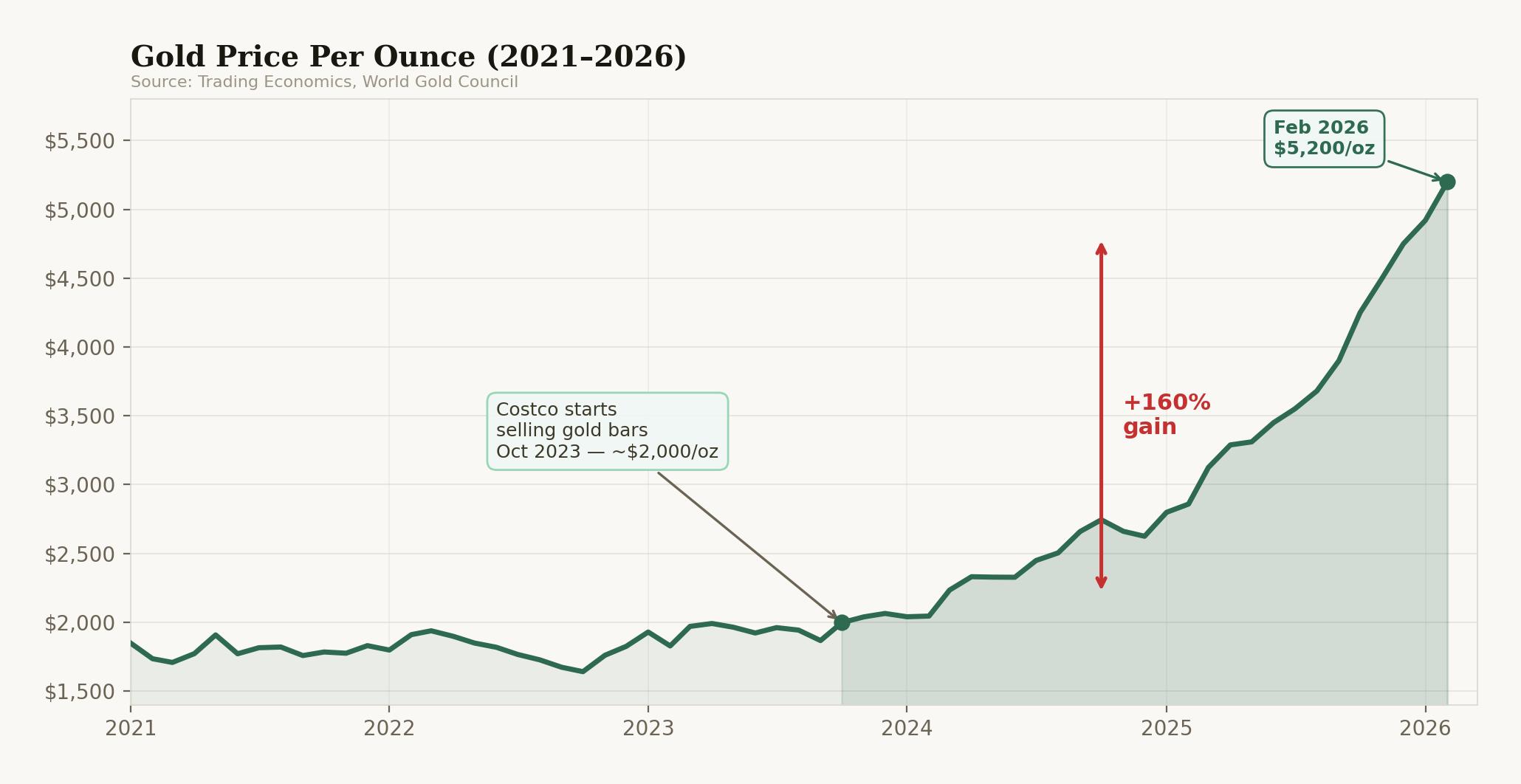
Gold is above $5,000/oz — more than double the price when Costco started selling bars in 2023. If you're sitting on a big gain, the IRS has a surprise: gold isn't taxed like stocks. Here's how it actually works.
Last updated: March 2026 · Tax year: 2026Costco gold bars are collectibles under IRC §408(m)(2) and taxed at up to 28% federal on long-term gains — not the 15-20% rate that applies to stocks. Your cost basis is what you paid Costco (including any membership-adjusted price). If you sell within a year, gains are taxed as ordinary income up to 37%.
The Costco Gold Boom, by the Numbers
Since mid-2023, Costco has been selling 1-ounce gold bars online — PAMP Suisse, Royal Canadian Mint, and other reputable brands — at roughly 2% over spot price. They've been selling out within hours of each restock, with the company reportedly moving $100–200 million in precious metals per month.

Gold spot price has surged from roughly $2,000/oz in late 2023 to over $5,000/oz in February 2026. That means a gold bar purchased at Costco for ~$2,040 could now be worth over $5,100 — a gain of more than $3,000 per bar.
That gain is taxable. And it's not taxed the way most people expect.
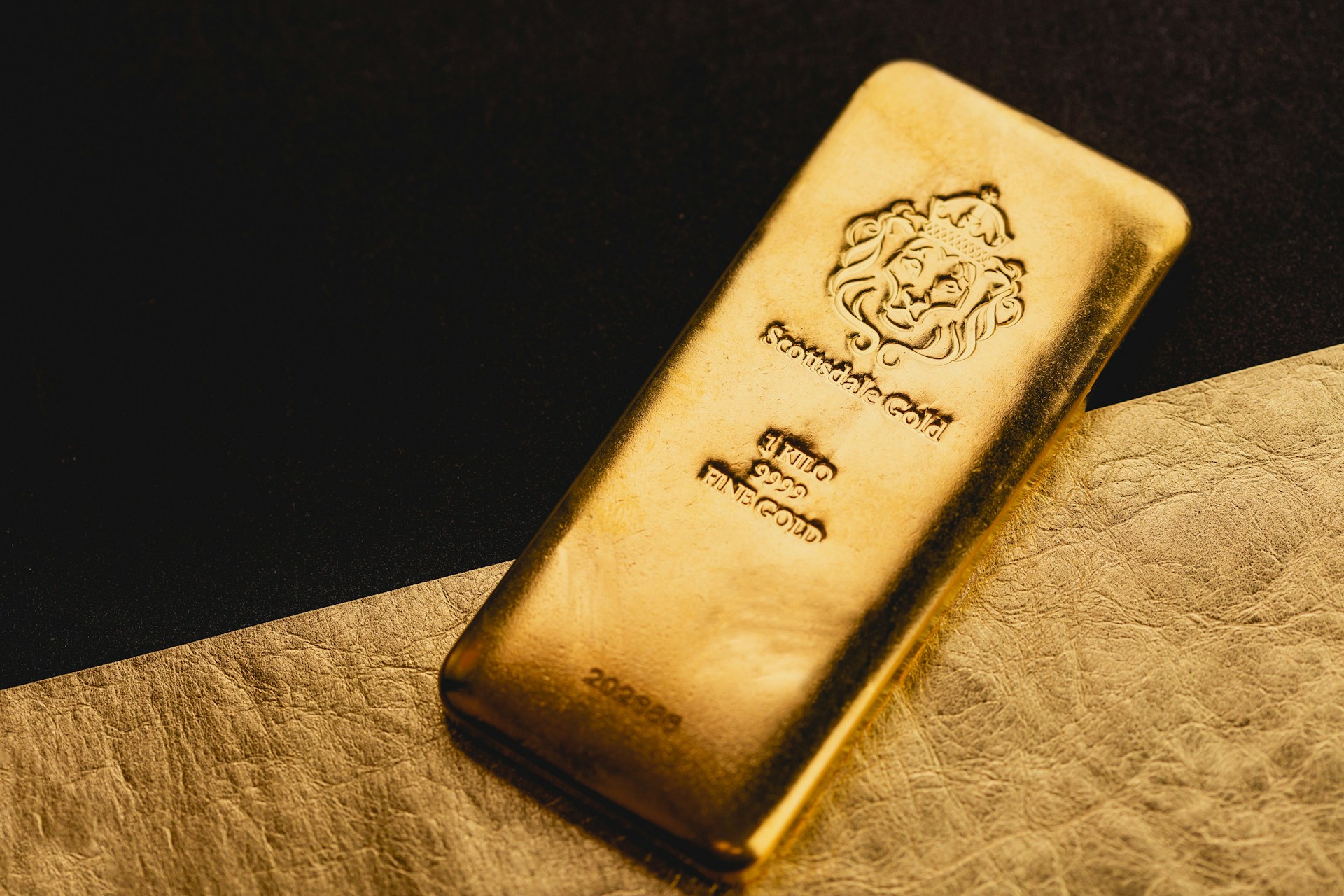
Most Costco gold buyers assume their profit will be taxed at the standard long-term capital gains rate of 0%, 15%, or 20% — the same as stocks. It won't. The IRS classifies physical gold as a collectible, which means the maximum federal tax rate is 28%, not 20%.
Why Gold Is Taxed as a Collectible
Under IRC §408(m)(2), the IRS defines collectibles to include "metals" — specifically gold, silver, platinum, and palladium. Gold bars, gold coins, and gold bullion of all types fall under this classification. It doesn't matter whether you bought them from Costco, APMEX, a local coin dealer, or a pawn shop. Physical gold is a collectible for tax purposes.
This classification has been in place since the Taxpayer Relief Act of 1997, which created a separate rate schedule for collectibles gains. The rate hasn't changed since.
What this means in practice: long-term gains on your Costco gold bar are taxed at your marginal income tax rate, but capped at 28% instead of the 20% cap that applies to stocks and real estate. If your marginal rate is below 28% (i.e., you're in the 10%, 12%, 22%, or 24% bracket), you pay your bracket rate. The 28% cap only kicks in for taxpayers in the 32% bracket or above. For a deeper explanation of how this bracket interaction works, see our complete guide to collectibles taxation.
Short-Term vs. Long-Term: Holding Period Matters
If you sell your Costco gold bar within one year of purchase, the gain is taxed as ordinary income at your marginal rate — which could be as high as 37%. There is no 28% cap for short-term sales.
If you hold for more than one year, the gain qualifies for long-term collectibles treatment — taxed at your marginal rate up to the 28% cap.
Bottom line: if you bought a bar in October 2023 and sell it today, you've held it for over a year. Long-term treatment applies. If you bought in January 2026 and flip it now, that's short-term — and potentially taxed at a higher rate.
The Full Tax Picture: Federal + NIIT + State
The 28% rate is just the federal base. Two additional layers can push your total tax rate much higher.
Net Investment Income Tax (NIIT)
If your modified adjusted gross income (MAGI) exceeds $200,000 (single) or $250,000 (married filing jointly), a 3.8% surtax applies to your investment income — including gold gains. This pushes the maximum federal rate to 31.8%.
State taxes
Most states tax capital gains as ordinary income. California adds 13.3%, New York adds up to 10.9%, New Jersey adds 10.75%. A few states — Florida, Texas, Nevada, Wyoming, Alaska, South Dakota, New Hampshire, and Tennessee — have no state income tax on capital gains. (Note: Washington state enacted a 7% capital gains excise tax in 2022, with rates up to 9.9% on gains above $1 million, though a standard deduction of ~$278,000 means most individual gold bar sales won’t trigger it.) For a full breakdown of how each state treats collectibles gains, see our state capital gains guide.
The combined maximum in California: 28% + 3.8% + 13.3% = 45.1%.
Example: Selling one Costco gold bar
| Line Item | Amount |
|---|---|
| Purchase price (Oct 2023) | $2,040 |
| Sale price (Feb 2026) | $5,100 |
| Capital gain | $3,060 |
| Federal tax (24% bracket) | $734 |
| NIIT (if MAGI > $200K/$250K) | $116 |
| California state tax (9.3% bracket) | $285 |
| Total estimated tax | $1,135 |
That's roughly 37% of the gain going to taxes for a California resident in the 24% bracket with NIIT exposure. For someone in the 32%+ bracket, the federal portion alone rises to 28%, pushing the total even higher. See our state-by-state capital gains tax guide for rates in all 50 states.
Estimate Your Tax
Our calculator handles the 28% rate, bracket stacking, NIIT, and all 50 state rates.
Calculate My Gold Bar Tax →What's Your Cost Basis?
Your cost basis is what you paid Costco for the bar. This includes their markup over spot price (typically ~2%). Keep your order confirmation email or Costco.com order history as documentation — our record-keeping guide covers exactly what to save and how long to keep it.
What adds to your basis
- The purchase price — the total amount charged by Costco, including their markup
- Sales tax — if your state charges sales tax on precious metals, the tax you paid increases your basis
- Shipping and insurance — if Costco charged separately for shipping (they typically offer free shipping, but confirm your order)
- Safe deposit box or storage fees — if you held the gold for investment purposes and can document the expense
For a complete walkthrough on tracking and maximizing your cost basis, see our Cost Basis for Collectors guide.
What does NOT reduce your basis
Credit card rewards and Costco Executive Member cash back do not reduce your cost basis. If you earned 2% back on a Costco Citi card, that's treated as a discount/rebate by the card issuer, not a reduction in what you paid for the gold. The IRS generally does not require you to reduce basis by credit card rewards.
Where to Sell and How It Affects Your Records
When you're ready to sell, the venue matters — both for the price you get and for record-keeping.
Local bullion dealers and coin shops typically offer 1–5% below spot for generic gold bars. You get immediate payment and an in-person receipt. Some large transactions may require the dealer to file IRS Form 1099-B.
Online bullion dealers (APMEX, JM Bullion, SD Bullion, etc.) will buy back bars at or near spot. Check their buyback premiums — they vary. You'll typically receive a check or wire transfer, and larger sales may generate a 1099-B.
Peer-to-peer / eBay / Reddit (r/Pmsforsale) can offer slightly better prices but come with added risk and no automatic tax reporting. You're still required to report the gain regardless of whether you receive a form. For platform-specific tax details, see our eBay, StockX & Whatnot tax guide.
"No 1099 means no tax." Wrong. The IRS requires you to report all capital gains whether or not a reporting form is issued. The 1099-K threshold ($20,000 and 200+ transactions, restored by the OBBBA in 2025) and dealer 1099-B reporting rules are about third-party reporting — your obligation to report exists independently.
Gold ETFs vs. Physical Gold: Tax Comparison
If you're comparing Costco gold bars to gold ETFs, the tax treatment is more similar than most people think — but there are important differences.
Physically-backed ETFs (GLD, IAU, SGOL) hold actual gold bullion in vaults. The IRS treats them as collectibles. Long-term gains are taxed at the 28% max rate — identical to physical bars. Additionally, these ETFs may generate taxable events from rebalancing or expense-related gold sales, even if you don't sell shares yourself. For a deep dive on ETF-specific issues like the 1099-B trap and K-1 complications, see our complete gold ETF tax guide.
Gold mining ETFs (GDX, GDXJ) hold shares of mining companies, not physical gold. They're taxed at the standard 0%/15%/20% long-term capital gains rate. This is one of the most significant and least-understood tax distinctions in gold investing.
Gold futures ETFs have yet another treatment — the 60/40 rule under IRC §1256 (60% long-term, 40% short-term regardless of holding period). These are relatively uncommon for retail investors.
State Sales Tax on Buying Gold
Most states exempt investment-grade gold bullion from sales tax. But "most" isn't "all." As of 2026, states that do charge sales tax on precious metals include New Mexico, Maryland, Maine, Vermont, Hawaii, Washington (as of January 2026), and the District of Columbia. Several other states have partial exemptions with minimum purchase thresholds. See our sales tax by state guide for the full rundown.
If you paid sales tax on your Costco gold purchase, that tax amount is added to your cost basis — reducing your taxable gain when you sell.
Costco Gold in an IRA
You cannot simply buy a Costco gold bar and put it in your IRA. IRA-eligible gold must meet IRS fineness standards (generally .995+ purity for bars) and be held by an approved custodian in a self-directed IRA. While Costco's bars (typically PAMP Suisse or Royal Canadian Mint, .9999 purity) may meet the fineness requirement, the logistics don't work — you'd need to purchase through the IRA custodian, not Costco directly.
Gold held inside an IRA grows tax-deferred. Distributions are taxed as ordinary income (for traditional IRAs) regardless of the collectibles classification. This means you lose the 28% cap but gain deferral.
Strategies to Reduce Your Tax Bill
The following are general tax concepts discussed in published tax literature. Whether any strategy is appropriate depends on your specific facts and circumstances. Consult a qualified tax professional before implementing any tax strategy.
There's no magic trick to avoid collectibles tax, but several legitimate strategies can reduce what you owe.
Spread sales across tax years. If you own multiple bars, selling one per year can keep you in a lower bracket. This is especially effective if selling a large position would push you into the 32% bracket (where the 28% cap starts saving you money) or trigger NIIT.
Harvest losses from other collectibles. Losses on investment collectibles (not personal-use property) can offset collectibles gains. If you have a losing coin or art position, consider selling it in the same year as your gold to reduce net taxable gain.
Maximize your cost basis. Document everything: sales tax paid, storage costs, shipping, insurance. Every dollar of documented cost reduces your gain dollar-for-dollar.
Gift to family members in lower brackets. If you gift gold to a family member in the 12% bracket, they'll pay 12% on the gain, not 28%. Be aware that gifts carry over the donor's cost basis, and annual gift exclusions ($19,000 per recipient in 2026) apply.
Donate to charity. If you've held the gold for over a year, donating it to a qualified charity lets you deduct the full fair market value without paying capital gains tax. An appraisal is required for donations over $5,000.
Hold until death. Under current law, inherited assets receive a stepped-up basis to fair market value at date of death. Your heirs would owe no capital gains on the appreciation during your lifetime. The OBBBA preserved this rule and increased the estate tax exemption to $15 million per person.
For more on how your IRS classification affects deductions and strategies, see our Dealer vs. Investor vs. Hobbyist guide.
How to Report Costco Gold Sales on Your Tax Return
When you sell a Costco gold bar at a gain, you report it on:
- Form 8949 — list each sale with date acquired, date sold, proceeds, cost basis, and gain/loss. Use Part II (long-term) for bars held over one year.
- Schedule D (Form 1040) — summarize your Form 8949 totals here. Long-term collectibles gains go on line 12 of Schedule D and are taxed at the 28% max rate.
Tax software like TurboTax and H&R Block do handle collectibles, but you often need to manually flag the sale as a "collectible" to ensure the correct rate applies. If the software defaults to the standard capital gains rate, your return will be wrong. Tax software like E-file.com and FreeTaxUSA
handle this on Schedule D and Form 8949. Our step-by-step reporting guide walks through Form 8949 and Schedule D with a worked example, and compares which tax software gets the 28% rate right.
Frequently Asked Questions
Yes. The IRS classifies physical gold — including Costco gold bars — as a collectible under IRC §408(m)(2). Long-term gains are taxed at a maximum rate of 28%, not the 15–20% rate that applies to stocks.
It depends on your income bracket, holding period, and state. Long-term gains are taxed at your marginal rate up to 28%. The 3.8% NIIT may also apply if your MAGI exceeds $200,000 (single) or $250,000 (MFJ). Use our calculator for an estimate specific to your situation.
Your cost basis is the total amount you paid Costco, including their ~2% markup over spot price. Sales tax (if charged in your state) also adds to basis. Keep your order confirmation as documentation.
Costco does not issue a 1099 for purchases. However, certain dealers must report specific quantities on Form 1099-B. Regardless, you are responsible for reporting all capital gains on your tax return.
Physically-backed ETFs (GLD, IAU, SGOL) are taxed at the same 28% collectibles rate. Gold mining ETFs (GDX, GDXJ) are taxed at the standard 0/15/20% rate. The structure matters more than the underlying metal.
Not directly. IRA-eligible gold must meet fineness standards and be held by an approved custodian in a self-directed IRA. While Costco's bars may meet purity requirements (.9999), they must be purchased through the custodian, not Costco.
If held as an investment, the loss can offset other capital gains plus up to $3,000 of ordinary income per year. Unused losses carry forward. If held as personal property, the loss is not deductible.
Most states exempt investment-grade gold bullion from sales tax. A few — including New Mexico, Maryland, Maine, and Vermont — do charge sales tax on precious metals. If you paid sales tax, it increases your cost basis.
Ready to file?
Tax software that handles Schedule D and Form 8949 for collectibles:
Looking to buy gold ETF alternatives? Physical gold dealers like JM Bullion and APMEX offer competitive pricing on bullion.
Ready to File Your Collectibles Taxes?
Compare tax software that handles the 28% collectibles rate on Schedule D and Form 8949:
Compare all tax software options · Estimate your tax first
Affiliate links — we may earn a commission at no cost to you. Disclosure
Sources
- IRC §408(m)(2) — Definition of collectibles including metals, gems, stamps, coins, alcoholic beverages, and works of art.
- IRC §1(h)(4)–(5) — Maximum 28% rate on net collectibles gain for long-term capital gains.
- IRC §1411 — 3.8% Net Investment Income Tax on investment income for taxpayers above MAGI thresholds.
- IRS Topic 409 — Capital Gains and Losses.
- One Big Beautiful Bill Act (OBBBA), signed July 4, 2025 — Restored 1099-K threshold to $20,000/200 transactions; preserved TCJA provisions; maintained stepped-up basis.
- CNBC, Sept 2025 — Reporting on Costco gold bar values, spot price of $3,549 as of Sept 3, 2025, and collectibles tax classification per Troy Lewis, CPA, BYU.
- Kiplinger, Feb 2026 — "Capital Gains on Collectibles: How They Are Taxed by the IRS in 2025," covering Costco gold, cost basis, and Form 8949 reporting.
- Fortune, 2024 — Reporting on Costco gold bar sales exceeding $100M per quarter and the 28% tax rate.